
Student purpose and agency are your guide to AI in education.
Artificial Intelligence offers educators abundant options to reinforce student learning, yet the pitfalls of AI use for young people are significant.
Data, Purpose, People helps schools determine what role AI should play in students’ lives in and out of the classroom, while ensuring that emerging AI tools never replace young people’s curiosity, problem-solving, and independent thought.
Clear Strategies. Less Noise.
Since ChatGPT’s release in November 2022, educators, parents, and those responsible for student learning have witnessed an overwhelming change in how students and young people can complete work. According to a 2025 survey by the College Board, 84% of high school students used AI in some form in their schoolwork. Among college students, 90% have used AI in their classwork and 61% have used it regularly.
Yet educators and school leaders are divided about how the role AI can play in education. A similar 2025 College Board survey directed at school leaders shows that roughly 2 in 5 schools do not allow student AI use, while 55% of schools do not have specific policies in place. Additionally, there has been a proliferation of AI tools sold to schools, many with bold claims of potential success. Most importantly, emerging AI use has had a significant impact on the socio-emotional learning of young people, where chatbots and AI use can result in withdrawal, increased anxiety, and struggles with cognitive and emotional independence. Young people themselves see the risks of AI use in their lives, and want guidance on the best ways to use it to support rather than define their ideas and well-being.
These tools should never replace curriculum and instruction, but can be used to reinforce what great educators teach. Data, Purpose, People works with schools, educators, leaders, and interested individuals to determine if and how institutions can and should encourage and utilize artificial intelligence in schools, and how to do so while ensuring students remain independent minded, innovative, and excited about learning new things.



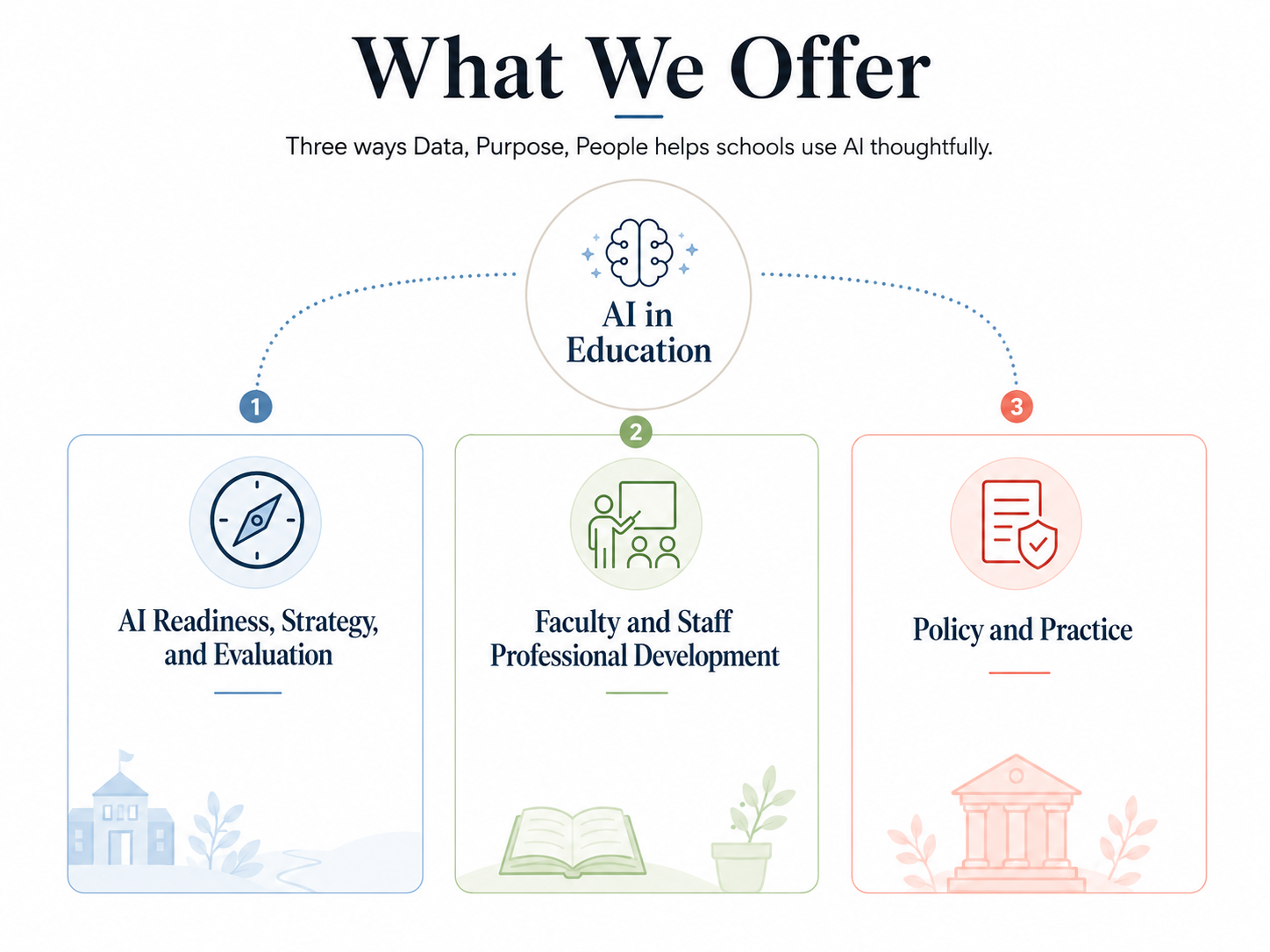
What we offer
AI Readiness, Strategy, and Evaluation
Data, Purpose, People helps schools understand and clarify where emerging technology like artificial intelligence fits their mission, operations, and strategic planning. It also includes where to resist AI implementation to keep teaching and learning strong.
Faculty and Staff Professional Development
Data, Purpose, People supports educators in understanding the opportunities and risks of artificial intelligence in planning, instruction, reinforcement, and assessment. This professional development allows educators to ensure that they are on the forefront of understanding artificial intelligence and similar emerging technology.
Policy and Practice
Because there is no universal framework on ideal AI use for students’ academic and emotional learning, Data, Purpose, People works with schools to develop customizable and clear guidelines for student learning. These policies and practices ensure educators have guidance on when to embrace and when to question AI usage in student learning.
Frequently Asked Questions
-
If we assume that 80% to 90% of students have used AI in their schoolwork, being prohibitive in its use may not be effective. The best answer is not a binary yes/no, but rather how schools can teach students to use it in ways that still preserve real learning.
-
AI is a wonderful tool to reinforce learning but should never be used to replace curriculum and instruction. I help schools distinguish between AI use that supports thinking — brainstorming, feedback, revision, accessibility, organization — and AI use that replaces the thinking students are supposed to do themselves.
-
Educators benefit from professional development and policies so that they do not feel alone. If schools design a curriculum that highlights and assesses individual thought, educators can transition from seeing AI as a tool to prevent to assessing creativity and original thinking.
-
AI can help with planning, differentiation, feedback, brainstorming, practice, and administrative tasks. But it should be used where it strengthens teaching and learning, not where it weakens student effort, teacher judgment, relationships, or the purpose of an assignment.
-
Faculty benefit from professional development that starts with their real questions. Demanding adoption will increase these concerns, but a teacher who sees the benefit of a new tool to improve their teaching (AI or otherwise) may feel less overwhelmed.
-
Ethical AI usage starts with understanding how AI works and how, if we allow it to happen, it can be used in ways that harm or hurt. Its ethical use is no different than the ethical use of any tool; when we understand something, and we understand its drawbacks and benefits, we can be more likely to use it effectively and ethically.
-
To preserve creativity, students must understand what AI cannot replace: asking questions, challenging concepts, and thinking independently. AI should never drive our thought process, but it can support us as we decide what we want to know.
-
Collaborative, honest, and straightforward. We're here to guide the process, bring ideas to the table, and keep things moving.
“The aesthetic in a person is that by which he immediately is what he is; the ethical is that by which he becomes who he is to become.”
Søren Kierkegaard
Either/Or