Did we really need to get chickenpox?
I don’t remember when I had chickenpox, but I do know two things: I had it, and I had it when I was very young. The conventional wisdom I recall is that their children should get chickenpox when they are very young, as it will be far milder than getting it when they get older, and they will have lifetime immunity against it. I don’t remember the “chickenpox parties” that millennials my age sometimes talk about, when parents would have one young child with chickenpox associate and infect several other young children. I do have a memory of my sister getting chickenpox, then me getting chickenpox, and then never having to think about it again. This may be a moot point now, as there has been a chickenpox vaccine for thirty years. But at some points, for my parents in the 1980s, getting chickenpox was an experience that would be far easier younger than older. They sought out short-term pain for a long-term benefit, and I haven’t had to think about it since. There’s a chance I could develop shingles later in my life, but other than that, getting the disease young has potentially saved me from more pain.
This might be a more extreme example, but it is a well-documented example of how experiencing something early is better than putting it off and facing its consequences later. This can happen often with learning: we learn languages better when we learn them at a young age, we can better learn musical instruments at a young age, and we can recover from brain injuries like a stroke more rapidly at a young age. Going back to my previous blog post, it is a lot easier to learn how to ride a bike when a young child rather than as an adult. There are biological and societal reasons for all of this; chief among them is that young children might not be as aware or care as much if they are likely making a mistake, allowing them to learn from experience rather than worrying if they are right or wrong. But I would venture the main reason is a term that is often thrown around but not always defined: neuroplasticity.

This is probably a nicer image than actual chickenpox
Eight years ago, Jonathan Haidt (and his co-author, Greg Lukianoff) wrote The Coddling of the American Mind. This examined a shift on college campuses where students were increasingly uncomfortable with ideas different from their own. Part of their argument is that those students, the first termed by Jean Twenge as iGen (or more commonly today, Gen Z), had lives that were heavily planned out by parents and authority figures, and these students were less likely to have needed to solve emotionally uncomfortable situations on their own because the authority figures in their lives were more likely to step in, advise, or solve them for them.
Haidt focuses on this question more fully in his book The Anxious Generation, which notes that the loss of unsupervised play and freedom has changed young minds. Children learn to resolve conflicts and deal with failure on their own. As the brain ages into adolescence, the prefrontal cortex (which handles our critical reasoning and executive functioning) develops as well; when young people use their brains in ways of social friction, they develop their prefrontal cortices. Yet our young people are losing opportunities for risk-taking in lives that are more highly controlled, and the advent of phones and digital devices has made this more profound. Thus, young people have less experience in resolving social friction and are more likely to experience anxiety because they have not developed the coping mechanisms throughout their earlier life.
Neuroplasticity is the brain’s ability to strengthen itself based on a number of stimuli and experiences. When someone repeatedly performs a task and practices a skill, the neural pathways needed to complete that skill strengthen, making it easier for the brain and the person to complete that skill. A thought process becomes automatic (like procedural memory). Yet this does involve the physical rewiring of the brain, and brain cells grow and establish new bridges across cells. Without neuroplasticity, we (and our brains) would be far less likely to acquire new skills and learn how to operate in new environments. Our brain is like a muscle, and we can develop it just like every other muscle in our body. Consider a forest without any pathways or trails. The first time we try to walk through that forest, it’s really challenging! But after we establish trails, moving is much easier. Our brains are similar! If we let our brain be a dense forest, it will never truly develop. But if we connect different neurons with new paths, ideas can move around much more easily.
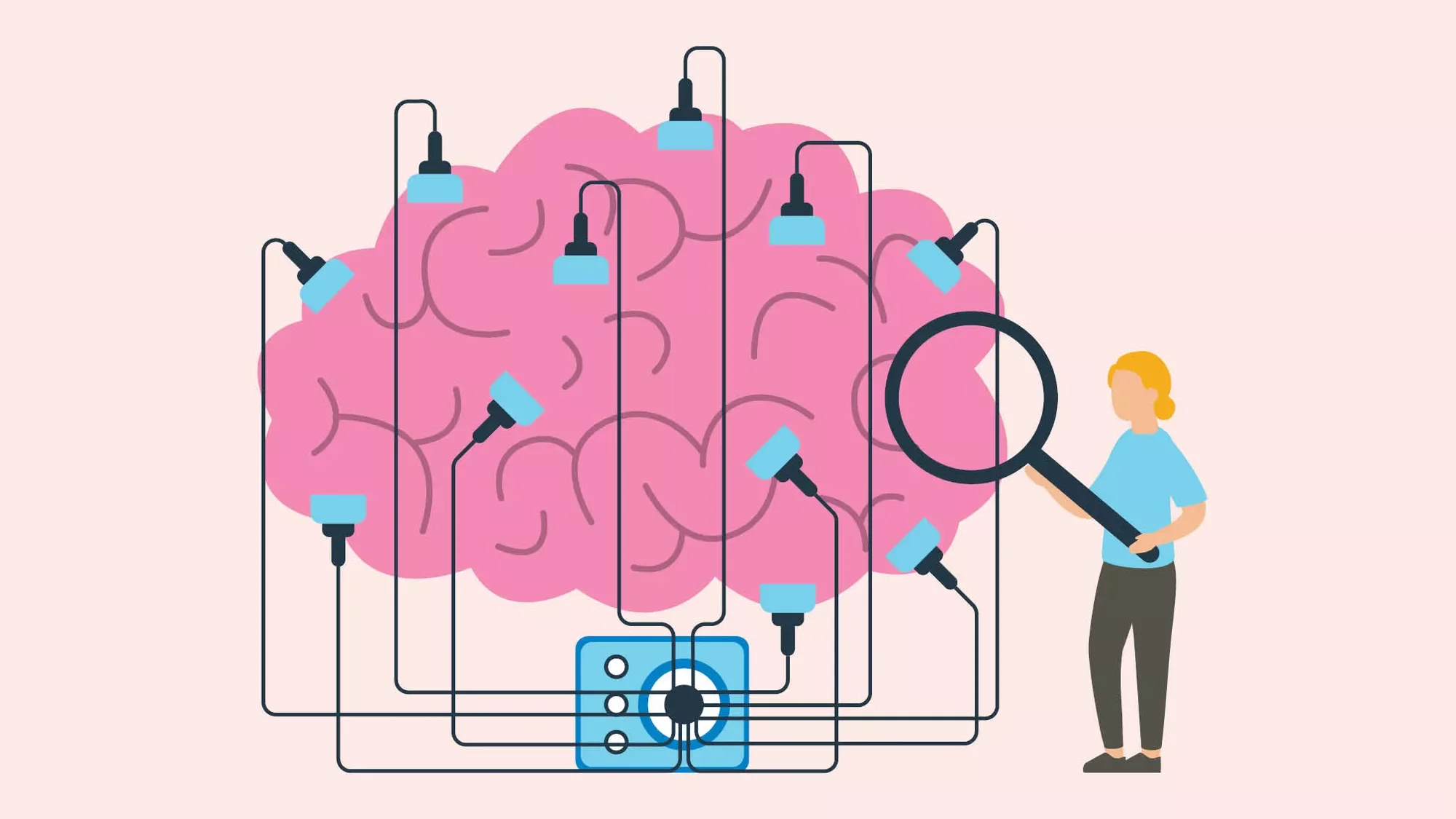
Neuroplasticity, per the Cleveland Clinic
Since The Anxious Generation came out in 2024 (and was likely written in the years before it), AI has exploded in its capabilities and usage. He and his writing team in their Substack newsletter After Babel noted that AI chatbots offer a substitute for human relationships that warps how the human mind works. Real human relationships, like the successful relationships I have with my wife, family, friends, and colleagues, require boundary-setting and compromise. LLMs and AI chatbots offer unlimited patience and a laser-like focus on the user. They offer complete self-validation at a time in life when young people so desperately want it, and this will only increase the anxiety that is already present in young people.
The solution, as I see it, is not to eliminate the use of LLMs and AI for young people in their lives, because I don’t think that is practical or particularly helpful. If a tool exists, people are going to find a way to use it; imagining it doesn’t exist or trying to prevent its usage will likely fail. Additionally, AI tools give the user instant feedback, and that instant feedback can be so useful to someone who wants to learn. Going back to the forest analogy: if I am stuck in a forest, I need to find my way out of it. If an AI tool can help me find my way, that’s great! If I rely on AI all the time, I’m no longer thinking. If I ask an AI tool to build paths and then never learn why they're built that way, I have learned nothing and never will. Young people and adolescents are at a time in their lives when they have to learn so much. The key is to prevent AI from doing the easy work for them, and to encourage them to think! One concept I am considering is creating an AI agency framework that educators and those responsible for students can use to highlight and promote this cognitive friction in students' lives so they can reflect on how they have maintained their ability to think for themselves and for their brains to develop. At the heart of this work is how we frame optimal use of technology with young people; I don’t think we can eliminate the potential of people using AI to outsource our learning entirely, but I do think we can do a lot.
So what does this look like in practice in the real world? Imagine a thirteen-year-old student struggling with a rapidly changing understanding of the world around them, who is struggling with friendships changing and more challenging schoolwork and likely discomfort about their place in the world. Rather than cognitive offloading, we should encourage the AI to push that student to have better ideas and to give instant feedback. This can work in an academic sense (instead of asking an LLM to solve a geometry problem, provide three problems on this concept of varying difficulties and tell them what they got right and wrong). But this can be transformational in developing a student’s social and emotional well-being if done right. Instead of using the AI tool to validate, one thing we can encourage our young people to do is have emerging AI tools explain what they as learners do not understand. Rather than get validation from an AI tool that they are right in an argument with a peer or a friend, have the tool build that person’s capacity for understanding and solving the issue: understand why their friend acted that way in the first place, walk through potential tricky talking points, and give that young person the chance to exercise their mind and think through how to solve that particular thorny situation.

Even if that means deciding which of our old toys to keep
My parents, and many other parents of millennials, knew that getting chickenpox at a young age would prevent us from significant pain in our future years. We have the opportunity to do something similar for our young people today in the world of emerging AI. Getting chickenpox at a young age helped my body learn how to fight it, and helped my immune system develop further. Our brains are no different, and we need our AI use to help us build those pathways ourselves. Otherwise, we’ll be lost in the woods forever.
Thinking isn’t like riding a bike
There are many rites of childhood that we experience, and those shift depending on when we grew up and where we lived. But one that is common to so many people in America and around the world is learning to ride a bicycle. Bikes are used across cultures and can be ridden at an early age; there is something universal about that first bike ride without training wheels, where we learn to balance ourselves and do something fully independent. And it sticks with us for the rest of our lives! We will never forget how to ride a bicycle, no matter how long it's been since the last time we’ve done so.
I haven’t thought about how to ride a bike for years. I’ve just done it. It’s muscle memory that I can carry on without thinking about how it works. Boston has a bike share program (“Bluebikes”, sponsored by Blue Cross and Blue Shield), and it is nice to stop at a subway stop, hop on a bike a few blocks, and drop it off at one of the hundreds of other bike terminals around the city. If you’ve ridden a bike in Boston, or any other city, this ease of remembrance is key. There are so many unpredictables: other drivers, pedestrians, potholes, and a lot of other general obstacles. If I had to think about how to ride that bike, I would have a lot more trouble riding it and be far more stressed out by everything I wish I could think about instead.
Note that this doesn’t mean we multitask. There is only one task. I’m not riding a bike and juggling, or riding my bike and checking my phone. I’m monotasking, but I’m able to think critically while I do so. We do this with so many skills that we learn throughout life. When I first learned to drive, my focus would solely be on the road, and all my thoughts would be on driving. I still have one task (driving), but I can listen to the radio, take a call over Bluetooth, or think about work, school, family, or what on earth other drivers are doing on the road. Depending on how experienced you are as a driver, these aren’t really considered multitasking (despite what my mother told me when I was sixteen).
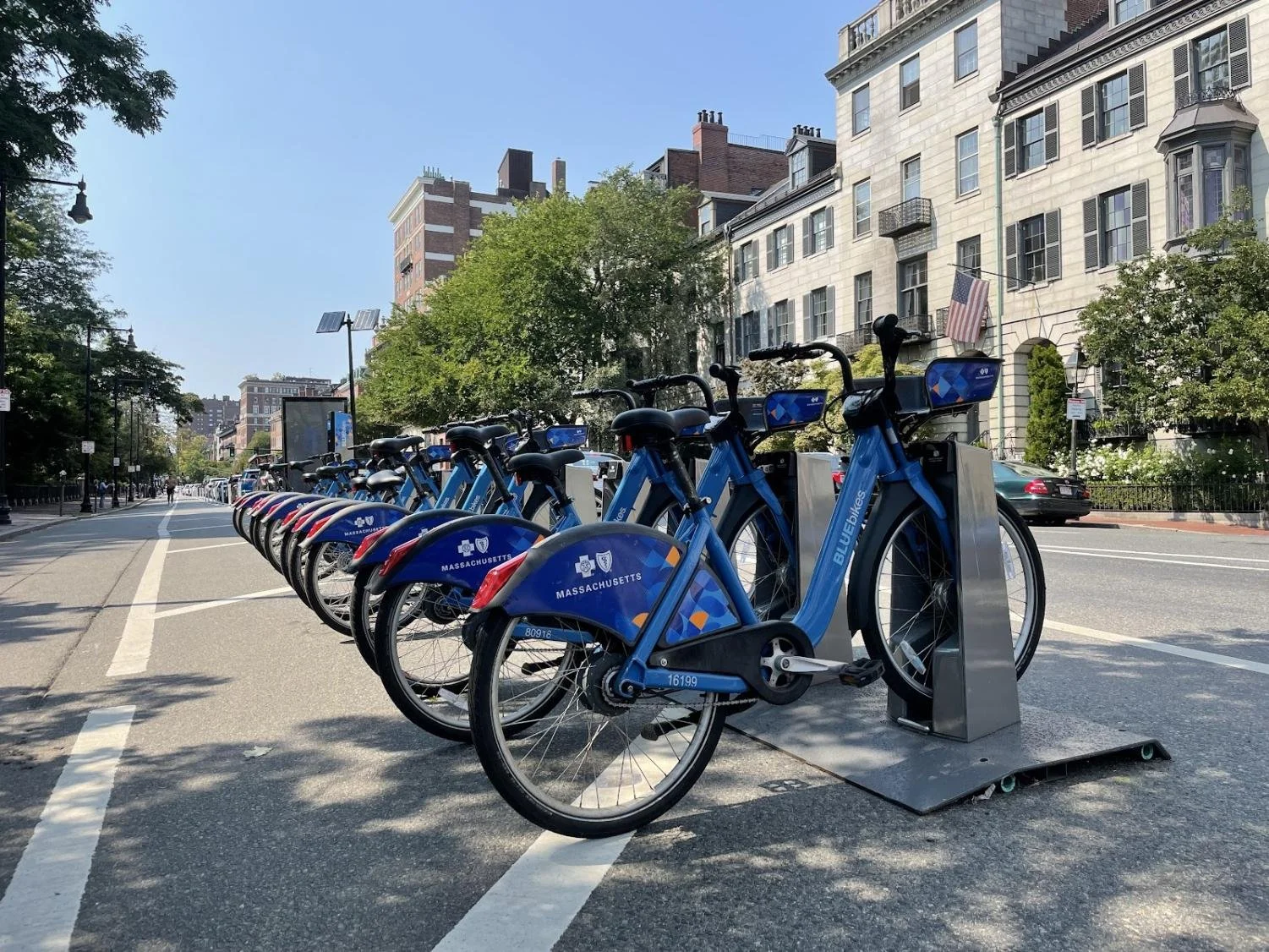
These bikes are available throughout the city of Boston
This is an example of procedural memory. There is a task that I understand fully (riding a bike), and because of this, I can think about something that I probably find much more enthralling and interesting: what I see while riding, and where I am going. We do this throughout our lives. On the whole, this is a good thing, and while there might be some concerns with multitasking or doing too many things, this procedural memory lets us focus less on simple tasks and more on complex thinking. I run a lot, but I don’t necessarily love to run. I find the thought process that comes from running to be really fruitful though, and one reason why is that I don’t have to think about how to run at what pace I need to target; I can just think about a presentation for work, what to get my wife for her birthday, or the nature of the universe. Our favorite tasks and hobbies are that which we can do while we think about other things too. In short, our procedural memory has allowed us to think cognitively in ways we otherwise could not.
This is different from cognitive offloading, where we shift our thinking onto an external source. This can be useful as well. In my earlier Bluebikes examples, I don’t have to think about where the docking station is; I can check my phone and it will tell me where to take my bike when I’m done using it. If I’m stuck in traffic, Google Maps can tell me how to get to where I’m going and I don’t need to take out a road map to do so. In learning, we have used cognitive offloading for years, and it can be useful in supporting further thinking. If I am learning Calculus, a calculator can do arithmetic faster, allowing me to focus on how to best solve a problem. Additionally, I can memorize the Product and Chain rule to help me solve more complex problems, even I don’t fully understand the logic behind them. But there are many more examples where cognitive offloading replaces thinking rather than supporting it. We all likely remember a test or quiz from our youth where we memorized definition for terminology in some class, regurgitated that information on an assessment, got a good grade, and remembered nothing. While a calculator helps with arithmetic, using it may make us more dependent on the tool in the future; it is easier to type 67 times 44 in the calculator rather than reason it out, and maybe that makes 67 times 4 more difficult if we are not using critical thinking to solve problems.
Yet today, with technological advances in artificial intelligence, LLMs, and greater technology cognitive offloading is easier than ever. AI can write a paper for me, solve a whole calculus problem, provide answers to a multiple-choice quiz, and despite what its detractors say it is more often right than wrong in regards to a simple task. An LLM can break each part of a question or a problem into tasks, and provide an answer that is most likely to provide a good answer (even if it is not perfect). But note that this is very different from procedural memory! With procedural memory, I know how to do something but I don’t have to think about it. With cognitive offloading I don’t have to think about it, but I am more likely to never learn how to do it. Gerlich (2025) notes that there is a significant negative correlation between persistent AI usage and a loss of critical thinking. This is especially impactful on young minds, who are more likely to become dependent on these tools and more likely to negatively impact their critical thinking.

A novel solution to a problem
Let’s take the role of devil’s advocate here. So what?
So what if people don’t have to think as much about the cognitive problems they face in life? This gives them a chance to think about more complex tasks, right? If I have a paper to write, I can write my ideas into the prompt and it will turn those ideas into something real; I’ve saved valuable time to write more papers, or research what I want to research. Perhaps I have too much to accomplish in life; AI allows me to accomplish more, do more, make more money, and be more confident it is good work. Perhaps now AI can accomplish my work for me, so I can take on my true passions: painting, playing music, volunteering in my community.
If you’re reading that, you’re right to doubt that kind of thinking, for a variety of reasons. When was the last time someone saved twenty minutes on a task and then used that time to canvass for political change, build a community garden, or clean up a city park, rather than spend it endlessly scrolling on a phone? Yet one issue it brings up is the power that cognitive offloading takes away from us as humans. Krullaars et al. (2023) note that this loss of critical thinking impacts our engagement with what we are supposed to be learning. Rather than use this time to think more critically, we actually care less about it.
But some of the greatest innovations in history come when cognitive offloading isn’t possible; we have to think about how to solve a problem to do something we care about and love. For example, an engineer named Spencer Silver had trouble making a new adhesive for aerospace engineering that would stick but could be removed easily, but others at 3M did not see the practical implications of it and it stayed unused and undeveloped. At least it did until another engineer, Art Frey, grew frustrated at church because the bookmarks he put in his hymnal kept falling out. But he remember Silver’s technology, and sued this technology to create bookmarks that could stick in the hymnal but be easily replaced or changed for the next service. If those sound familiar, they should. It’s called a sticky note, a solution without a problem until someone found the problem it could solve.
If I really loved riding a bike, I would pay attention to those details, about how I could ride it better, and become an expert. Maybe I’d build a better bike. This friction is essential in our learning. Artificial intelligence is not going to replace that original problem solving. It can tell us what is most likely going to be the problem, but not what we feel, from our experience, is the real problem. If we retain our thinking, and ensure that we aren’t offloading our thinking on to the LLM, that’s a great step and these tools can do this if we ask. But it is not the default setting, and it can lead to dependence on a tool which impacts the way we think.

Credit to Chris Yaw for this lovely image
In the bike analogy earlier, there’s a critical moment in our development as bike riders and as people. We have to take off the training wheels. That moment, as a kid, can be really scary! And if you remember closely enough, you probably fell, skinned your knee, and failed a number of times before getting there. But now, years later, you know how to ride a bike. That friction from taking off our training wheels helped us learn a task forever. We have to keep taking off the training wheels in our thinking, even if it is more difficult.
I can call this “intentional friction”, where we deliberately seek out challenges rather than avoiding them. Yet in our current education mindspace, I don’t think we necessarily embrace this way of thinking; you have an assessment, you do it or you don’t, and then you move on. Bjork and Bjork (2011) note that this can be an obstacle to long term learning, and that we see familiarity of ideas as learning rather than knowledge or wisdom, and that continuing along this path may make future learning feel more difficult. They call these challenges ‘desirable difficulties’ and argue that such friction can improve long-term retention. In the age of AI, where we have so many things to reinforce our learning, it is easier than ever to offload our thinking to something else, but if we do this, we will never be able to take the training wheels off how we think.
Citations:
Bjork, Elizabeth L., and Robert A. Bjork. “Making Things Hard on Yourself, but in a Good Way: Creating Desirable Difficulties to Enhance Learning.” Psychology and the Real World: Essays Illustrating Fundamental Contributions to Society, edited by Morton Ann Gernsbacher et al., Worth Publishers, 2011, pp. 56–64.
Gerlich, Michael. “AI Tools in Society: Impacts on Cognitive Offloading and the Future of Critical Thinking.” Societies, vol. 15, no. 1, 2025, article 6. MDPI,https://doi.org/10.3390/soc15010006.
Walter, Yoshija. “Embracing the Future of Artificial Intelligence in the Classroom: The Relevance of AI Literacy, Prompt Engineering, and Critical Thinking in Modern Education.” International Journal of Educational Technology in Higher Education, vol. 21, 2024, article 15. Springer Nature,https://doi.org/10.1186/s41239-024-00448-3.
What Defeating the Spartans Can Tell us about AI
It All Begins Here
As a long-time Ancient History teacher, I have a soft spot for Classical antiquity, especially the lives of the Greeks. It was a time of rapid growth in human accomplishments and the human condition. Greek thinkers made monumental advances in philosophy, mathematics, astronomy, medicine, art, architecture, and government that we still utilize today. I had a college professor years ago who noted that the population of Athens during antiquity was 200,000 to 300,000 people. That’s a lot of people for antiquity, but no different from the city population of Richmond, Virginia today. Nothing against Richmond, one of my favorite cities in the country, but it will never match the technological and cultural impact of Athens or the other city-states of Hellas.
Yet for all the advances in human thought during this time period, it is easy to overlook the constant warfare and instability present in Ancient Greece. We see pretty common narratives of the Greeks as a united front against others (against Troy in the Iliad and during the Persian Wars against Persia), yet the Greek city-states were far more likely to fight amongst themselves. During the Athenian Golden Age of the 5th and 4th Centuries BCE, Athens was more likely to be at war than at peace, and this turmoil among Greek city-states only ended when they were collectively defeated by Philip of Macedon. Athenian, Corinthian, and Ionian Greeks made tremendous advances in the human condition, but could never understand peace.
When we think about Greek warfare, we are likely to think about Sparta. Unlike Athens and other Greek city-states, Sparta had no accomplishments in mathematics, architecture, sculpture, or drama. However, Sparta has many accomplishments in warfare. Spartans trained for war from youth, and full-blooded Spartan citizens (called “Spartiates”) were the most feared warriors in the known world. It was the purpose of the Spartan citizen to excel militarily and to never surrender. A famous Spartan saying was "Ή ταν ή επί τας", which translates to “With your shield or on it”; Spartans were to either return to Sparta victorious holding their shields or die in battle, carried on them by their surviving peers. And Sparta famously thrived as a military power, consistently defeating their enemies. Even when they lost, like at Thermopylae as made famous from the movie 300, they fought bravely to the death and were recognized for their battle prowess. When Spartans did surrender, such as at the Battle of Sphacteria in the Peloponnesian War against Athens and her allies, it was shocking.
For centuries Sparta was the military powerhouse of Ancient Greece. But in one day at the Battle of Leuctra, that logic fell apart; the Spartan army faced a devastating loss to the one of the most innovative Greek military minds of his time, Epaminondas of Thebes.
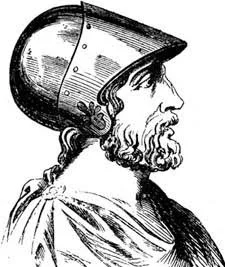
Epaminondas of Thebes
Epaminondas is not as well known as his contemporaries in other Greek city-states (Pericles in Athens, Leonidas in Sparta), perhaps because his home of Thebes was destroyed by Alexander the Great only thirty years after his death. However, those who lived in antiquity thought the world of him: the famed historian Xenophon admired him more than any other Greek leader, and Cicero referred to him as “the first man of Greece.” He displayed the qualities that Greeks held in high regard: he was patriotic, had a strong moral compass, and despite being a very strong student and athlete, remained modest (he was never guilty of hubris!)
Sparta and Thebes had tussled for power for years before Leuctra. Sparta had marched armies to Thebes with the intent to reconquer the city-state, however, Thebes refused to fight them, creating earthworks and walls to keep Sparta out; during that time, Epaminondas and Thebes trained for when the battle would occur. And it did, at Leuctra in 371 BCE. Sparta marched north with 10,000 hoplite infantry, including 700 elite Spartiates, far outnumbering the 6,000 Theban soldiers.
In hoplite warfare, soldiers held their shields with their left hand and their spears with their right hand. However, this could result in the phalanx shifting rightward as soldiers led with their spear over their shield. Thus, for centuries, commanders put their strongest soldiers on the right side of their phalanxes. However, Epaminondas placed his strongest soldiers on the left side of the Theban phalanx, and placed more soldiers on the left flank (a row of fifty rather than a row of twelve), making the row deeper. When the battle commenced, the elite Spartan soldiers faced far more resistance than anticipated.
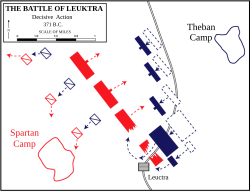
A map of Leuctra, Thebes in blue
The results were catastrophic for Sparta. The right flank quickly fell apart, killing 1,000 men and 400 of their elite Spartiate soldiers (including the King). Other Spartan soldiers, seeing their most elite soldiers struggling and dying, quickly fell apart and retreated. Sparta lost up to 4,000 of their troops, while Thebes lost no more than a few hundred. After the victory, Epaminondas marched to Sparta and freed the helots, whom Sparta had enslaved for hundreds of years. Additionally, Sparta had often maintained allies due to their power and intimidation. They had lost, but they had never been crushed. Finally, Sparta only had so many full-blooded Spartiates, and consistent fighting kept them away from home and away from having children. There were only 800 full Spartiates by the time of Leuctra, and Thebes had killed half of them. Sparta remained a physical city-state, but its aura was gone.
With Sparta severely weakened, Epaminondas led a decade of Theban dominance, where Thebes took the place of Sparta in influencing Greek politics. As a result, nine years later at the Battle of Mantinea, Thebes faced Sparta again with the help of Athens and other city-states looking to weaken Thebes. And once again, Epaminondas and Thebes won and defeated Sparta in the biggest hoplite battle in Greek history. Yet Epaminondas never saw the aftermath of this victory, and died in battle. Twenty years later, Philip of Macedon used Epaminondas’ tactics to defeat a weakened combination of Greek city-states and conquer them.
Epaminondas had thrived because he created a new strategy and solution to a problem that no one else before him considered. Some historians see his decision to put his strongest soldiers on his left flank as a strategic choice, others have noted it could have been a spur-of-the-moment decision to fight off a rapidly approaching enemy. But it changed warfare forever; had he not taken on this strategy, Philip of Macedon could not have followed his ideas, and perhaps Greece resists Macedonian invasion and Philip’s son Alexander never becomes Great.
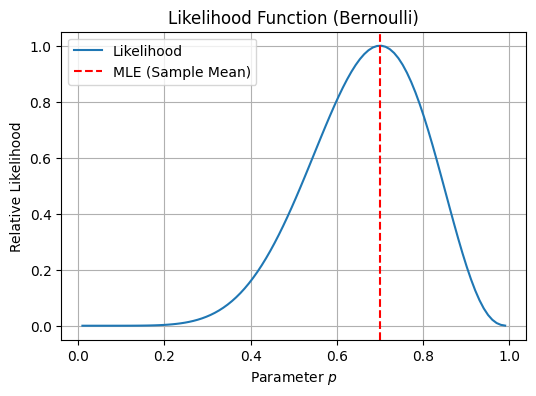
A Bernoulli likelihood function, the foundation of modern LLMs
So what does this have to do with artificial intelligence? And what does this have to do with the need for thinking?
If we look at Large Language Models (LLMs) and other forms of artificial intelligence, they do not have a foundational understanding of human language and understanding. And barring some unforeseen technological advances, they never will. What they are exceptional at is predicting the likelihood of an event taking place. This could include the likelihood of a basketball player scoring X number of points, the likelihood of a patient developing a chronic health condition, and in the case of LLMs, the likelihood that the next word in a sentence sounds like human language. What is striking in the past five years has been the growth in how effective these AI models are in understanding how so many different variables impact the likelihood of an event happening. This includes the likelihood of a basketball player scoring two or three points if they are matched up against a given defender, playing in the 27th minute of a game, and recovering from a sprained ankle, all with 3:02 left in the 3rd quarter. This includes the likelihood of a 40 year old otherwise healthy patient developing breast cancer based on where they live, who their parents are, and thirty other factors that we could not quantify until recently. This includes me asking an LLM what I can make for dinner using the leftover ingredients in my fridge. They consider data and variables, calculate likelihood of events happening, and then produce an answer with the highest likelihood of being correct. This is revolutionary, and has led to significant changes in how we as humans live. Most are for the best! I can get instant feedback on anything my mind desires, and the responses have, given the training data we use, a high likelihood of being right. It still fascinates me that there can be so much variation in the responses; I can ask an LLM a question 10 times, and get variety in the answers that probably are all equally informative.
However, there are drawbacks. One that I have been considering a lot recently is what happens when AI use stops being supportive and starts being dependent. As a basketball coach, I want to utilize the likelihood of a player on my team scoring a basket, but I don’t want to give up trust in my own judgment. It should never replace me knowing my players, knowing strategy, and seeing actions in real time to determine the best action to take. Researchers have called this “cognitive offloading” where while AI helps individuals produce better work, the output of that work becomes homogeneous. In an article in Science, researchers noted that when users were able to use AI to help write stories, they were able to write works that were seen as more creative. However, these stories were not unique and the outputs of AI-assisted or produced work lacked creativity and individualism. In our hope to be right, accurate, or impressive, we are producing work that reads like everything else.
I have worked in education for 20 years as a teacher and administrator, and what I have loved about teaching is helping and seeing people learn. AI tools are wonderful tools to promote learning when the product is based around the likelihood of a correct answer. However, Epaminondas did not think this way; if he had been able to ask ChatGPT what to do to defeat the Spartans, it would have given the rule that had worked best before that: to put the best soldiers on the right. The human condition that thrived in Ancient Greece was to invent new ways to understand the world, and we cannot let a dependence or an overuse of artificial intelligence take that away from us.
I created Data, Purpose, People to maintain the humanity in the world of AI. As a long time educator, I look at this through the lens of education and encouraging us all to maintain what makes us human: our ability to think for ourselves. Emerging AI technology may make it easier for us to check boxes, to fulfill a rubric, and to accomplish tasks, but those are always based around maximizing likelihood to ensure we are as close to an answer as possible. Yet an answer does not always mean the right answer.
Works Cited:
Anil R. Doshi, Oliver P. Hauser, Generative AI enhances individual creativity but reduces the collective diversity of novel content. Sci. Adv, 10.So what does this have to do with the artificial intelligence? And what does this have to do with the need for thinking?