Thinking isn’t like riding a bike
There are many rites of childhood that we experience, and those shift depending on when we grew up and where we lived. But one that is common to so many people in America and around the world is learning to ride a bicycle. Bikes are used across cultures and can be ridden at an early age; there is something universal about that first bike ride without training wheels, where we learn to balance ourselves and do something fully independent. And it sticks with us for the rest of our lives! We will never forget how to ride a bicycle, no matter how long it's been since the last time we’ve done so.
I haven’t thought about how to ride a bike for years. I’ve just done it. It’s muscle memory that I can carry on without thinking about how it works. Boston has a bike share program (“Bluebikes”, sponsored by Blue Cross and Blue Shield), and it is nice to stop at a subway stop, hop on a bike a few blocks, and drop it off at one of the hundreds of other bike terminals around the city. If you’ve ridden a bike in Boston, or any other city, this ease of remembrance is key. There are so many unpredictables: other drivers, pedestrians, potholes, and a lot of other general obstacles. If I had to think about how to ride that bike, I would have a lot more trouble riding it and be far more stressed out by everything I wish I could think about instead.
Note that this doesn’t mean we multitask. There is only one task. I’m not riding a bike and juggling, or riding my bike and checking my phone. I’m monotasking, but I’m able to think critically while I do so. We do this with so many skills that we learn throughout life. When I first learned to drive, my focus would solely be on the road, and all my thoughts would be on driving. I still have one task (driving), but I can listen to the radio, take a call over Bluetooth, or think about work, school, family, or what on earth other drivers are doing on the road. Depending on how experienced you are as a driver, these aren’t really considered multitasking (despite what my mother told me when I was sixteen).
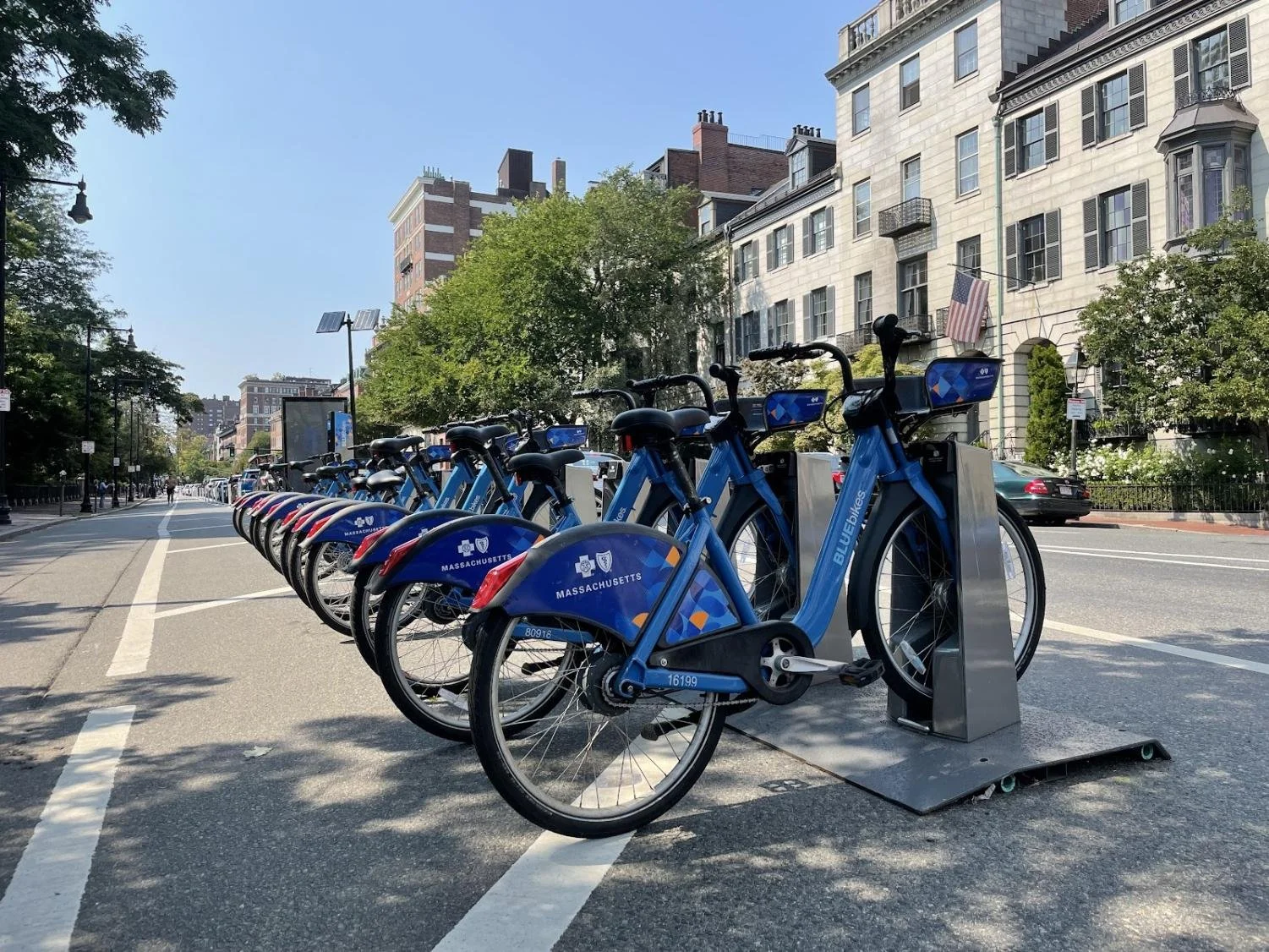
These bikes are available throughout the city of Boston
This is an example of procedural memory. There is a task that I understand fully (riding a bike), and because of this, I can think about something that I probably find much more enthralling and interesting: what I see while riding, and where I am going. We do this throughout our lives. On the whole, this is a good thing, and while there might be some concerns with multitasking or doing too many things, this procedural memory lets us focus less on simple tasks and more on complex thinking. I run a lot, but I don’t necessarily love to run. I find the thought process that comes from running to be really fruitful though, and one reason why is that I don’t have to think about how to run at what pace I need to target; I can just think about a presentation for work, what to get my wife for her birthday, or the nature of the universe. Our favorite tasks and hobbies are that which we can do while we think about other things too. In short, our procedural memory has allowed us to think cognitively in ways we otherwise could not.
This is different from cognitive offloading, where we shift our thinking onto an external source. This can be useful as well. In my earlier Bluebikes examples, I don’t have to think about where the docking station is; I can check my phone and it will tell me where to take my bike when I’m done using it. If I’m stuck in traffic, Google Maps can tell me how to get to where I’m going and I don’t need to take out a road map to do so. In learning, we have used cognitive offloading for years, and it can be useful in supporting further thinking. If I am learning Calculus, a calculator can do arithmetic faster, allowing me to focus on how to best solve a problem. Additionally, I can memorize the Product and Chain rule to help me solve more complex problems, even I don’t fully understand the logic behind them. But there are many more examples where cognitive offloading replaces thinking rather than supporting it. We all likely remember a test or quiz from our youth where we memorized definition for terminology in some class, regurgitated that information on an assessment, got a good grade, and remembered nothing. While a calculator helps with arithmetic, using it may make us more dependent on the tool in the future; it is easier to type 67 times 44 in the calculator rather than reason it out, and maybe that makes 67 times 4 more difficult if we are not using critical thinking to solve problems.
Yet today, with technological advances in artificial intelligence, LLMs, and greater technology cognitive offloading is easier than ever. AI can write a paper for me, solve a whole calculus problem, provide answers to a multiple-choice quiz, and despite what its detractors say it is more often right than wrong in regards to a simple task. An LLM can break each part of a question or a problem into tasks, and provide an answer that is most likely to provide a good answer (even if it is not perfect). But note that this is very different from procedural memory! With procedural memory, I know how to do something but I don’t have to think about it. With cognitive offloading I don’t have to think about it, but I am more likely to never learn how to do it. Gerlich (2025) notes that there is a significant negative correlation between persistent AI usage and a loss of critical thinking. This is especially impactful on young minds, who are more likely to become dependent on these tools and more likely to negatively impact their critical thinking.

A novel solution to a problem
Let’s take the role of devil’s advocate here. So what?
So what if people don’t have to think as much about the cognitive problems they face in life? This gives them a chance to think about more complex tasks, right? If I have a paper to write, I can write my ideas into the prompt and it will turn those ideas into something real; I’ve saved valuable time to write more papers, or research what I want to research. Perhaps I have too much to accomplish in life; AI allows me to accomplish more, do more, make more money, and be more confident it is good work. Perhaps now AI can accomplish my work for me, so I can take on my true passions: painting, playing music, volunteering in my community.
If you’re reading that, you’re right to doubt that kind of thinking, for a variety of reasons. When was the last time someone saved twenty minutes on a task and then used that time to canvass for political change, build a community garden, or clean up a city park, rather than spend it endlessly scrolling on a phone? Yet one issue it brings up is the power that cognitive offloading takes away from us as humans. Krullaars et al. (2023) note that this loss of critical thinking impacts our engagement with what we are supposed to be learning. Rather than use this time to think more critically, we actually care less about it.
But some of the greatest innovations in history come when cognitive offloading isn’t possible; we have to think about how to solve a problem to do something we care about and love. For example, an engineer named Spencer Silver had trouble making a new adhesive for aerospace engineering that would stick but could be removed easily, but others at 3M did not see the practical implications of it and it stayed unused and undeveloped. At least it did until another engineer, Art Frey, grew frustrated at church because the bookmarks he put in his hymnal kept falling out. But he remember Silver’s technology, and sued this technology to create bookmarks that could stick in the hymnal but be easily replaced or changed for the next service. If those sound familiar, they should. It’s called a sticky note, a solution without a problem until someone found the problem it could solve.
If I really loved riding a bike, I would pay attention to those details, about how I could ride it better, and become an expert. Maybe I’d build a better bike. This friction is essential in our learning. Artificial intelligence is not going to replace that original problem solving. It can tell us what is most likely going to be the problem, but not what we feel, from our experience, is the real problem. If we retain our thinking, and ensure that we aren’t offloading our thinking on to the LLM, that’s a great step and these tools can do this if we ask. But it is not the default setting, and it can lead to dependence on a tool which impacts the way we think.

Credit to Chris Yaw for this lovely image
In the bike analogy earlier, there’s a critical moment in our development as bike riders and as people. We have to take off the training wheels. That moment, as a kid, can be really scary! And if you remember closely enough, you probably fell, skinned your knee, and failed a number of times before getting there. But now, years later, you know how to ride a bike. That friction from taking off our training wheels helped us learn a task forever. We have to keep taking off the training wheels in our thinking, even if it is more difficult.
I can call this “intentional friction”, where we deliberately seek out challenges rather than avoiding them. Yet in our current education mindspace, I don’t think we necessarily embrace this way of thinking; you have an assessment, you do it or you don’t, and then you move on. Bjork and Bjork (2011) note that this can be an obstacle to long term learning, and that we see familiarity of ideas as learning rather than knowledge or wisdom, and that continuing along this path may make future learning feel more difficult. They call these challenges ‘desirable difficulties’ and argue that such friction can improve long-term retention. In the age of AI, where we have so many things to reinforce our learning, it is easier than ever to offload our thinking to something else, but if we do this, we will never be able to take the training wheels off how we think.
Citations:
Bjork, Elizabeth L., and Robert A. Bjork. “Making Things Hard on Yourself, but in a Good Way: Creating Desirable Difficulties to Enhance Learning.” Psychology and the Real World: Essays Illustrating Fundamental Contributions to Society, edited by Morton Ann Gernsbacher et al., Worth Publishers, 2011, pp. 56–64.
Gerlich, Michael. “AI Tools in Society: Impacts on Cognitive Offloading and the Future of Critical Thinking.” Societies, vol. 15, no. 1, 2025, article 6. MDPI,https://doi.org/10.3390/soc15010006.
Walter, Yoshija. “Embracing the Future of Artificial Intelligence in the Classroom: The Relevance of AI Literacy, Prompt Engineering, and Critical Thinking in Modern Education.” International Journal of Educational Technology in Higher Education, vol. 21, 2024, article 15. Springer Nature,https://doi.org/10.1186/s41239-024-00448-3.
